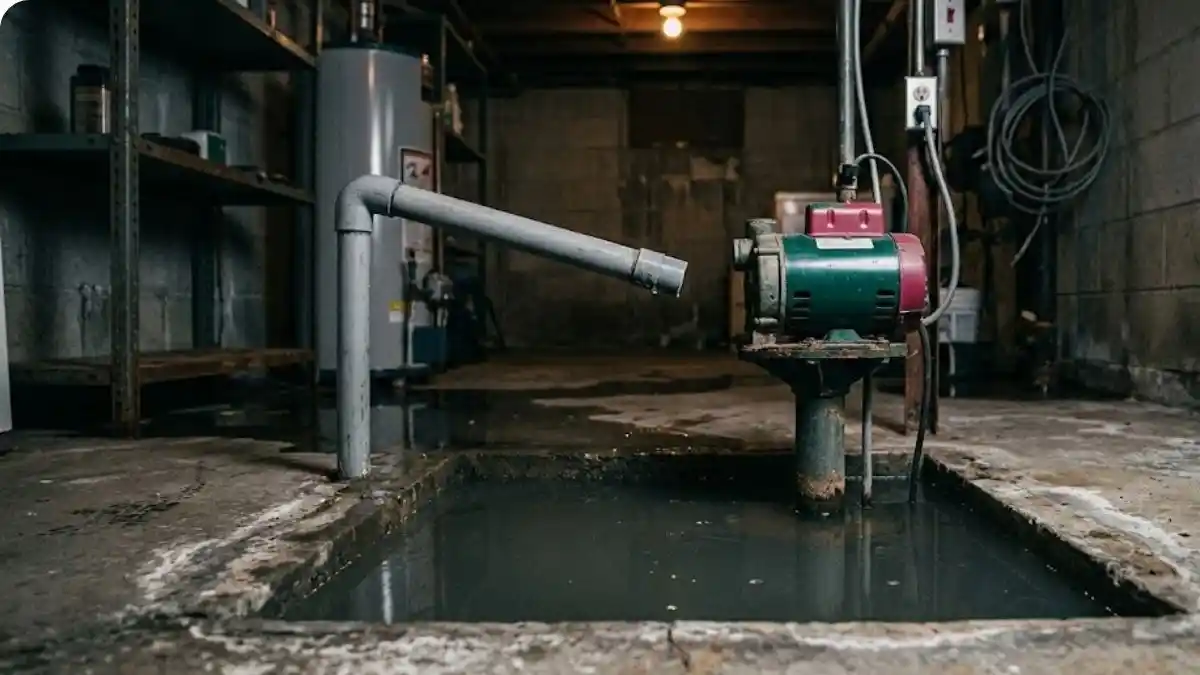
The Pohick Creek watershed runs through much of west Springfield, and summer convective storms in Fairfax County arrive fast and drop water faster than the area's drainage infrastructure was designed to handle. When those two facts combine with a sump pump that hasn't been tested this season, basements that have been dry for years can fill in under an hour.
Here is what actually happens when your sump pump fails - and how flooded basement cleanup in Springfield works from the moment you call.
Why Sump Pumps Fail During Springfield Storms
The most common failure mode during a storm event is power loss. Your pump is doing exactly what it's supposed to do, moving water from the pit to the discharge line, when a lightning strike or overloaded circuit takes out your electrical panel. The pit fills in minutes. Then the basement floor drain can't keep up, and water spreads.
| Failure Type | Frequency | Prevention |
|---|---|---|
| Power outage during storm | Most common | Battery backup pump or water-powered backup |
| Float switch malfunction | Common | Annual float switch test before storm season |
| Check valve failure | Moderate | Annual valve inspection |
| Pump overcapacity (insufficient GPM) | Common in major storms | Upgrade to higher-capacity pump for flood-prone lots |
| Pump age/wear | Increases after 7 years | Replace every 7-10 years proactively |
The First 30 Minutes After Discovering Your Flooded Basement
Before doing anything else, confirm power is off to the basement. A flooded basement with live circuits is a life-safety issue. Cut power at the breaker to the basement before entering standing water.
Then call (571) 708-6074 immediately. Here's why the first-30-minutes decision matters more than most homeowners realize: flooded basement cleanup starts with water category assessment - and your cleanup approach depends entirely on what type of water you're dealing with.
What Type of Water Is in Your Springfield Basement?
Sump pump failure floods are almost always Category 1 (clean water from the drainage system) or Category 2 (groundwater with some soil contamination). If your floor drain is backing up simultaneously - brown water with odor - you're looking at a potential Category 3 (sewage) event from municipal system surcharge, which is a fundamentally different response.
| What You See | Likely Category | Implication |
|---|---|---|
| Clear/clean water, no odor | Cat 1 | Most salvageable - prompt extraction protects most materials |
| Slightly discolored, mild odor | Cat 2 | PPE required; some materials may require removal |
| Brown/black water, sewage odor | Cat 3 | Do not enter without PPE - full biohazard protocols apply |
What Happens After Professional Extraction
Standing water removal is the beginning, not the end, of flooded basement cleanup in Springfield. After extraction, the real work is structural drying - removing bound moisture from concrete, drywall, wood framing, and insulation that will continue causing damage (and mold) if not addressed. This is where professional equipment matters: LGR dehumidifiers operating in a sealed environment pull moisture from structural materials in ways that consumer equipment cannot replicate.
For finished basements in Springfield's housing stock, extraction and drying decisions depend on what materials are involved. Drywall that was saturated for more than 24-48 hours by Category 1 water often requires flood-cutting (removing the bottom 12 inches) to dry the wall cavity and framing behind it. This is not optional - it's the standard that prevents the mold discovery 4 weeks later.
Protecting Your Springfield Basement Before the Next Storm Season
The most effective prevention is the simplest: test your sump pump before storm season each year. Pour a bucket of water into the pit and confirm it activates and pumps. Install a battery backup system if you don't have one - power outage during the storm that causes flooding is the most common scenario. Consider a water-powered backup for additional redundancy during extended outages.
For Springfield homeowners in areas closest to the Pohick Creek watershed, a perimeter drain system inspection every few years is a worthwhile investment. Older interior drain tile systems can clog or collapse without visible symptoms until they fail during a major storm event.
For any Springfield flooding emergency - sump pump failure, storm intrusion, basement backup - call (571) 708-6074 any hour.