Flooded Basement Cleanup in Fairfax, VA
Sump pump failure, groundwater intrusion, window well overflow - 24/7 basement flood cleanup across south Fairfax County.
📞 Call (571) 708-6074 - 24/7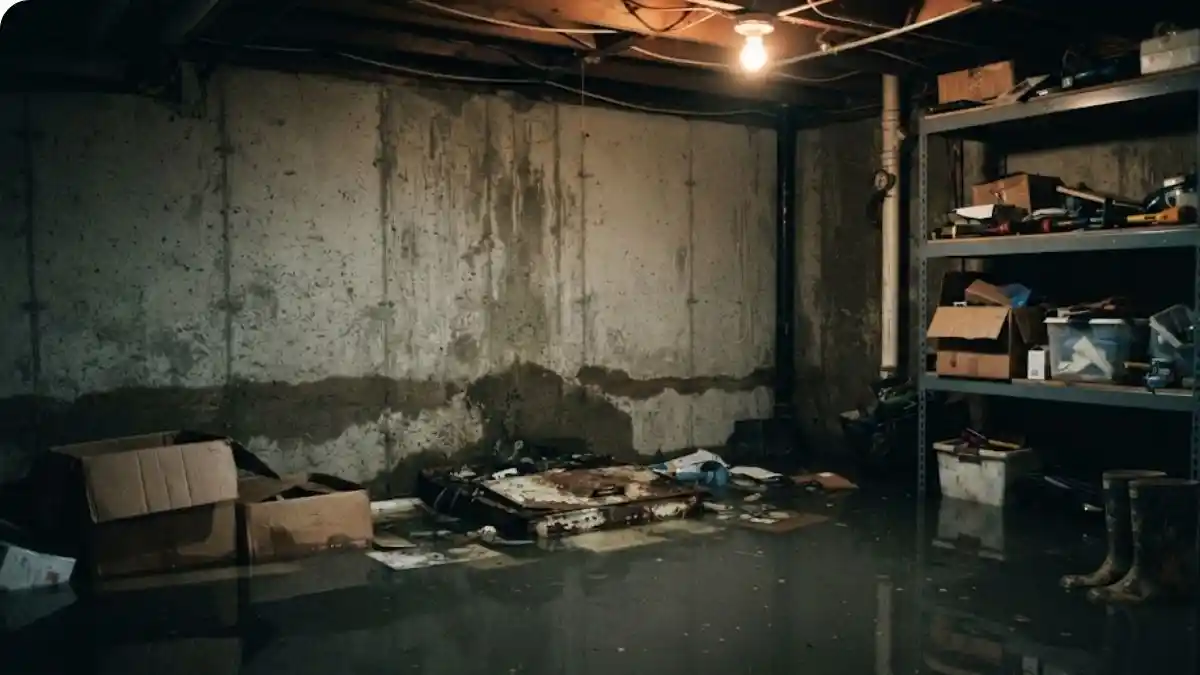
A flooded basement in south Fairfax County is almost never a simple pump-and-mop job. Fairfax County's clay-heavy soil holds water like a bathtub - during sustained rain events, hydrostatic pressure against foundation walls can push water through cracks, cove joints, and porous block even when there's no obvious entry point. Sump pump failures, window well overflows, and failed perimeter drain systems all end the same way: standing water in a finished or semi-finished basement, with the clock running on material salvage and mold prevention.
Call (571) 708-6074 any hour. Our crew serves south-county communities including Springfield, Burke, Lorton, Kingstowne, Fort Belvoir area, Hybla Valley, and Groveton.
Need emergency help right now for basement flooding?
(571) 708-6074Any hour - live dispatcher answers
How Fairfax Basements Flood - The Four Main Causes
Sump Pump Failure
The most common emergency call in south Fairfax County during and after storm events. Sump pumps fail for predictable reasons: power outage during the storm that causes flooding, float switch malfunction, check valve failure, or a pump that's simply aged out (typical lifespan 7-10 years). When the pump fails during a sustained rain event, the pit fills quickly and water follows the path of least resistance across the basement floor. Homes with finished basements absorb significant water before the overflow is even noticed.
Groundwater Through Foundation Walls
Fairfax County's Piedmont geology produces clay soils that expand when wet, creating lateral pressure against basement walls. Poured concrete foundations develop cracks at stress points over time; block foundations are inherently porous at mortar joints. Water seeping through foundation walls is Category 1 until it contacts soil contamination, then Category 2 or 3. This type of flooding often appears as water "wicking" up from the base of walls - a key sign the source is groundwater pressure, not a plumbing failure.
Window Well Overflow
Egress window wells and basement windows without proper drain systems back up during heavy rain. The water column against the window eventually overcomes the seal and enters the basement in volume. Homes built on lots with even slight downward grade toward the foundation are especially prone to this in Fairfax's summer convective storms.
Failed Perimeter Drain / Weeping Tile
Many Fairfax homes built before 1985 have aging or failed interior or exterior perimeter drain systems. When the drain tile clogs or collapses, water that would have been diverted to the sump pit instead surfaces inside the basement through floor-to-wall cove joints.
What Basement Flood Cleanup Involves
| Step | What Happens | Why It Matters |
|---|---|---|
| Source Identification | Trace entry point(s), check sump status | Ongoing entry stops cleanup from working |
| Water Category Assessment | Visual + meter check for sewage or soil contamination | Determines PPE requirements and material salvage |
| Extraction | Truck-mounted pump for standing water; specialty tools for carpet/pad | Removes bulk water before drying begins |
| Material Assessment | Evaluate drywall, insulation, flooring, framing | Identifies what must be removed vs. dried in place |
| Structural Drying | LGR dehumidifiers, air movers, wall cavity drying | Brings materials to dry standard per IICRC S500 |
| Antimicrobial Application | EPA-registered antimicrobial on affected surfaces | Suppresses mold colonization during drying phase |
| Documentation | Daily moisture logs, photo record | Supports insurance claim and demonstrates scope |
Finished vs. Unfinished Basement: What It Means for Your Claim
Finished basements significantly increase water damage scope and cost because drywall, insulation, carpet, and furnishings absorb and hold water for days. In many cases, the first six to twelve inches of drywall along the perimeter must be removed to allow wall cavities and studs to dry - this is called a flood cut, and it's a standard IICRC-recognized practice, not an upsell. Documenting this decision (with photos showing moisture readings above dry standard at the cut line) is essential for insurance claims.
Unfinished basements are far easier to dry but still require full moisture mapping of the concrete slab, block walls, and any wood framing. Concrete holds moisture long after the surface appears dry - a pinless moisture meter will show elevated readings for days.
Crawlspace Flooding
Crawlspace flooding is common in Fairfax Station, Clifton, and older parts of south Fairfax County. The confined space makes extraction and drying significantly more complex. Standing water in a crawlspace must be pumped out completely, the space treated with antimicrobial, and structural moisture in floor joists monitored carefully. Wet insulation in a crawlspace is almost always a removal-and-replace situation; it cannot be dried in place to an acceptable standard.
Need emergency help right now for flooded basement cleanup?
(571) 708-6074Any hour - live dispatcher answers
After the Flood: Mold Prevention in Fairfax's Humidity Profile
Fairfax County summers push indoor relative humidity into the 60-70% range even in finished conditioned spaces. After a basement flooding event, the combination of residual moisture in building materials and elevated ambient humidity creates near-ideal mold colonization conditions. Professional drying with daily monitoring is the primary prevention strategy. If water has been present for more than 48 hours before cleanup begins, a precautionary mold assessment is recommended before closing up walls.
Related Guides & Tools
Frequently Asked Questions - Flooded Basement Cleanup
Need Flooded Basement Cleanup Now?
Live dispatchers available - crews serving south Fairfax County around the clock.
(571) 708-6074