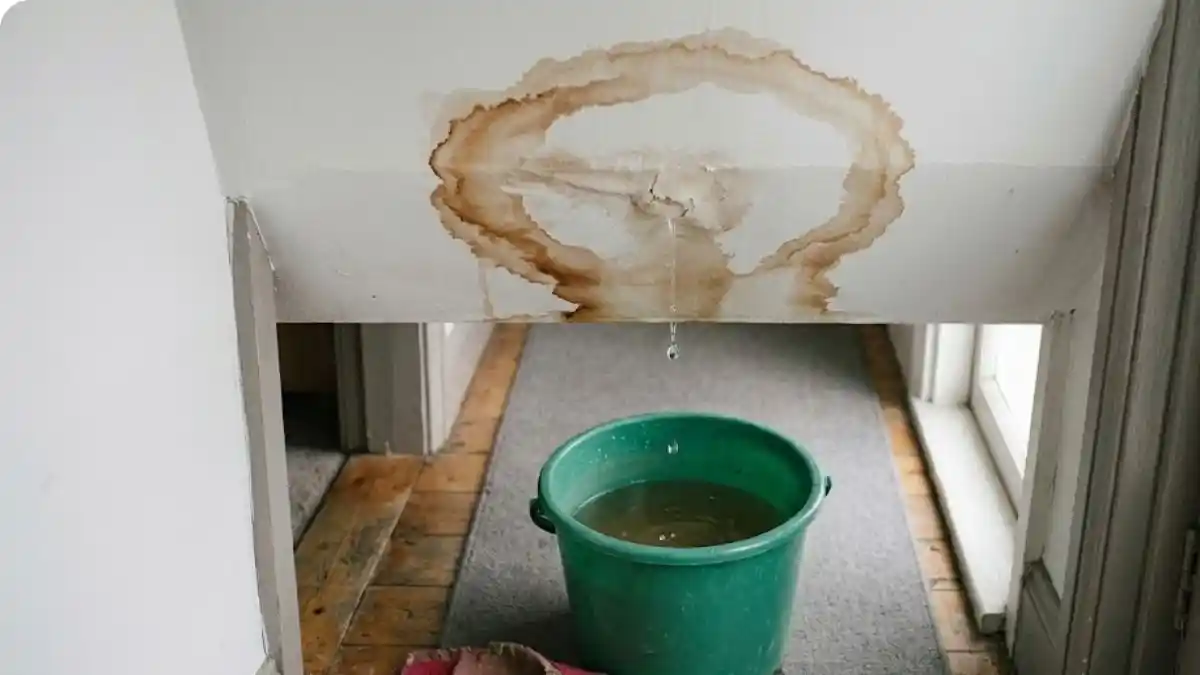
You notice a brown ring on the living room ceiling on a Wednesday morning. It's the size of a dinner plate, slightly wet to the touch in the center. The unit above you - you're in a Kings Park-area townhome - has a washing machine on the floor above the affected area.
Here is what's already happened inside your ceiling, and what your ceiling water damage assessment and insurance documentation need to cover.
What's Happening Inside a Water-Damaged Ceiling
The stain you see on your ceiling is the outward sign of a process that started hours before visibility. Water from the floor above travels through the floor assembly - the subfloor, floor joists, and the ceiling drywall below - following gravity and the path of least resistance. It pools at low points of the ceiling structure, often at junction boxes or light fixture locations.
By the time you see a stain, the ceiling drywall has typically been absorbing water for 6-12 hours. The insulation above it (if present) may be thoroughly saturated. The subfloor above may show moisture throughout the affected area. This is why ceiling water damage scopes in townhomes are almost always larger than the visible stain suggests.
Ceiling Water Damage Risk Levels
| Observation | Risk Level | Action Required |
|---|---|---|
| Small stain, ceiling firm and dry | Moderate - may be older or slow leak | Moisture meter assessment; check above for source |
| Wet or soft drywall, stain actively growing | High - active water event | Source control immediately + extraction |
| Sagging ceiling section | Emergency - structural failure risk | Evacuate below; do not enter until assessed |
| Water dripping from light fixture | Emergency - electrical hazard | Cut power to circuit; call immediately |
| Multiple stains in different locations | High - extensive spread through assembly | Full assembly assessment required |
Documenting a Unit-Above Ceiling Leak for Insurance
Ceiling water damage from a unit above involves multiple insurance parties. Your coverage applies to your contents and personal property. The unit above's homeowners policy is typically responsible for your structural damage if their negligence (a failed appliance, an overflowing fixture) caused the event. The building's HOA master policy may cover the structure.
Documentation that establishes the source - ideally a photo from the unit above showing the failed appliance or fixture - is essential for directing liability correctly. Our technicians assist with documenting the source when coordination with the unit above is possible.
The Ceiling Water Damage Assessment Process
Ceiling water damage assessment starts with moisture meters measuring drywall, the ceiling plane at multiple points around the visible stain, and - where accessible - the subfloor above. Thermal imaging identifies wet areas that haven't yet manifested as visible stains by showing temperature differential between wet and dry materials.
Based on the moisture mapping, our technicians determine whether the ceiling can be dried in place (with targeted dehumidification and possible air movers above the ceiling plane) or whether opening the ceiling is necessary to dry the assembly and confirm that mold conditions haven't been established. In most townhome ceiling leak scenarios involving wet for 12+ hours, some ceiling opening is required.
For Kings Park and Fairfax County ceiling water damage from any source, call (571) 708-6074 - live dispatch any hour.