Fairfax Water Damage Squad - emergency dispatch 24 hours per day.
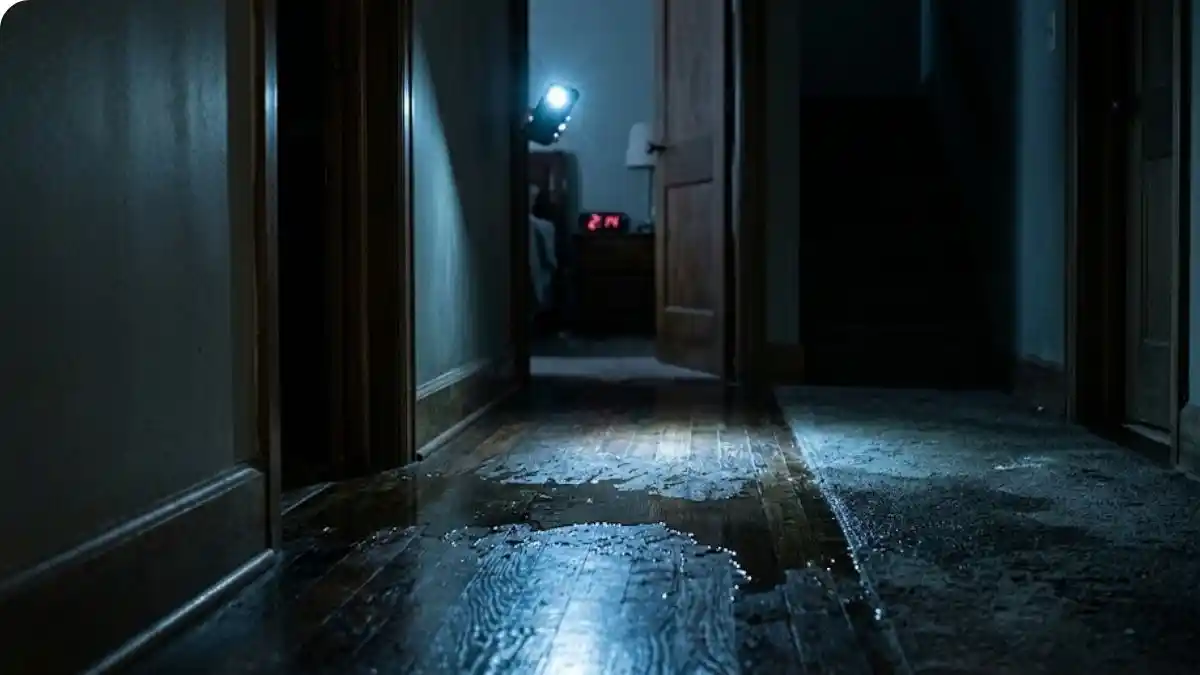
You wake up to a sound that doesn't belong - a hiss, a trickle, water running where nothing should be running at 2 AM. By the time you've found a flashlight and traced the sound, there's standing water on your basement floor or soaking through the drywall of a bathroom you were sure you'd locked down before bed.
Here is what to do, in order, right now.
Step 1: Find the Shutoff and Close It Immediately
The most important action in the first 60 seconds of a burst pipe emergency is stopping the water source. Every minute a supply line runs at household pressure (typically 40-80 PSI) releases 8-10 gallons of water minimum. Over 20 minutes, that's 160-200 gallons - enough to saturate a 400 square foot basement floor to a depth of half an inch, plus everything it can reach through subfloor gaps and wall cavities.
In most Fairfax County homes, the main shutoff is in one of three locations:
| Location Type | Where to Look | Valve Type |
|---|---|---|
| Basement utility room | On the wall closest to the street, near the water meter | Gate valve (wheel) or ball valve (lever) |
| Crawlspace | Near the foundation wall where the main line enters | Ball valve with lever handle |
| Exterior curb stop | In the utility box near the street - requires a curb key tool | Pentagon nut - utility company shutoff |
If you cannot find the shutoff or it won't close completely, call (571) 708-6074 right now. Our dispatcher will stay on the line with you and can guide you through the search while the crew mobilizes. Don't waste time searching alone in the dark.
Step 2: Cut Power to the Affected Area
Before entering any area with standing water, cut power to that zone at the breaker panel. Water and live electrical circuits are a lethal combination - especially in basements where electrical outlets, water heaters, sump pump wiring, and HVAC equipment are often at or near floor level.
If water is near your main panel and you're not sure whether it's safe to open it, call your utility company's emergency line first. Do not guess.
Step 3: Call Emergency Water Removal Crews - Before Doing Anything Else
Many Fairfax homeowners spend 30-60 minutes after shutting off the water trying to mop up or using a wet-vac before calling professionals. This instinct is understandable - the damage feels manageable at 2 AM when you're standing in two inches of water with a bucket. It isn't.
What's actually happening during those 30-60 minutes:
- Water is wicking up your drywall at roughly 1 inch per hour
- Subfloor wood is absorbing water and beginning to swell
- Water is traveling through subfloor gaps into wall cavities
- If it's a Cat 2 or 3 event, contamination is penetrating porous surfaces
- The clock on your hardwood floor save window is running
How emergency water removal actually works in Fairfax starts with category assessment - determining what type of water you're dealing with before a single drop is extracted. That determination controls everything from equipment selection to material salvage decisions.
Step 4: Document Before You Touch Anything
Your insurance claim starts with what you can show happened, not what you say happened. Before moving anything, before mopping up anything:
- Take wide-angle video walking through every affected room
- Photograph the water source and the visible failure point
- Note the time you discovered the event (write it down)
- Take close-up photos of the water level on walls and floors
If you can safely identify the source (a toilet supply line that's spraying, a fitting that's clearly failed), photograph it before touching it. This documentation is the foundation of your claim.
First-30-Minutes Decision Table
| Situation | Action | Reason |
|---|---|---|
| Water near electrical outlets | Cut power at breaker first, then enter | Electrocution risk is immediate |
| Can't find main shutoff | Call (571) 708-6074 - dispatcher guides you | Every minute counts |
| Water has odor or brown color | Do not enter without PPE | May be Cat 3 sewage or Cat 2 contamination |
| Hardwood floors affected | Call immediately - save window is 24-48 hours | Extraction within hours determines salvage |
| Multiple fixtures backing up | Call and don't flush or run water anywhere | Likely sewage main line backup - don't add volume |
What NOT to Do After a 2 AM Pipe Burst
Don't run fans or HVAC. Consumer fans and your HVAC system move air, but they move contamination too - spreading any bacteria or mold spores already present through the air and into ducts. Professional air movers are used strategically after extraction, not instead of it.
Don't use a household wet-vac as your primary extraction. Consumer wet-vacs typically move 1-3 gallons per minute. Professional truck-mounted extractors move 50-100+ gallons per minute. For a meaningful burst pipe event, consumer equipment extends the time standing water contacts materials - extending damage, not reducing it.
Don't wait until morning if the water source affected hardwood floors. The 24-48 hour save window for original hardwood begins the moment the water event starts, not when you wake up and call.
Our Service Area: Fairfax Station and South Fairfax County
Our crew serves Fairfax Station, Springfield, Burke, Lorton, Kingstowne, and all south Fairfax County communities from a single dispatch point. The 60-minute dispatch target is our operational ceiling - not a marketing claim - and it applies around the clock. A live dispatcher answers when you call (571) 708-6074 at 2 AM - not a call center, not a voicemail, not a system that promises a callback in the morning.
If you have water running in your Fairfax home right now, that call is the first step. Everything else follows.