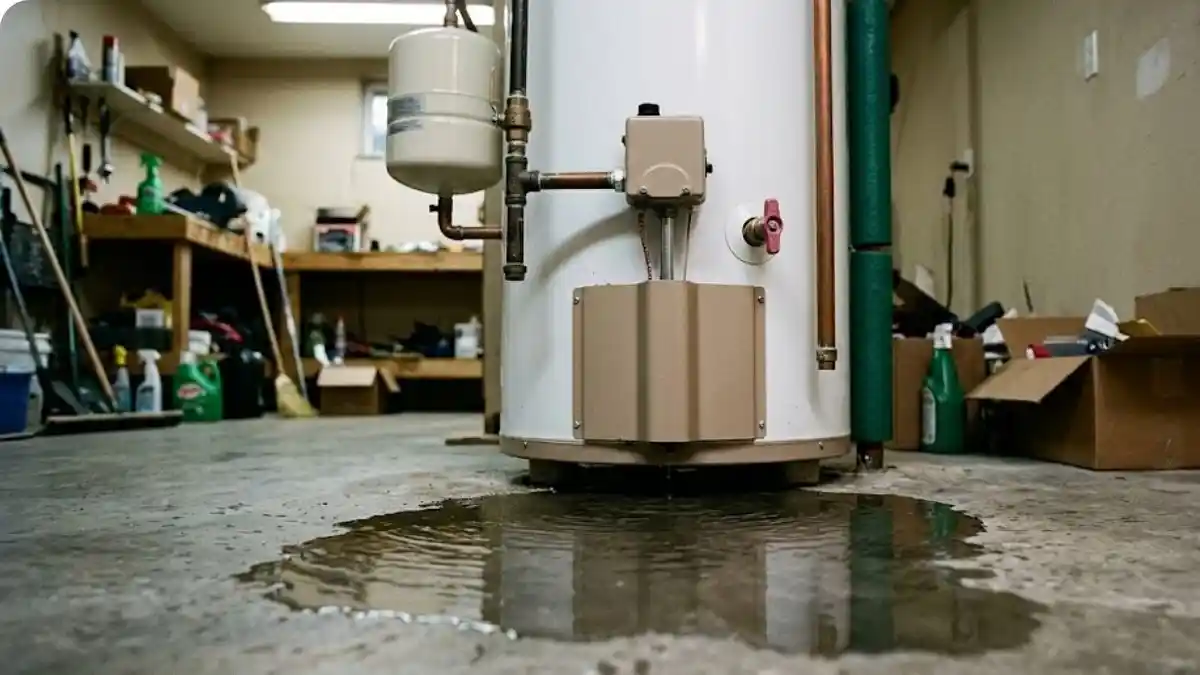
The average residential water heater in Fairfax County holds 40-80 gallons. When the tank lets go - and it can happen at any age past 8 years, but most commonly in the 10-15 year window - it releases that volume in minutes into your basement or utility room. The drain pan under the heater holds 2-4 gallons. The rest goes to the floor.
Here is what happens in your first 30 minutes, and why that window matters so much for what comes next.
Minutes 1-5: Stop the Source
If water is still flowing from the water heater - the tank is draining or the cold supply line to the tank is still pressurized - your first move is the water heater's cold water shutoff valve, which is typically a valve on the cold water line entering the top of the tank. If that valve is inaccessible or non-functional (not uncommon in older installations), shut off the main water supply to the home.
Confirm power: electric water heaters should have the breaker switched off immediately, as operating an element in a draining tank can damage the element. Gas water heaters have a gas supply valve that should be closed if the tank is compromised.
Minutes 5-15: Safety Check and Documentation
Before entering any water, check whether water has reached electrical outlets, the electrical panel, or your HVAC equipment. Water and live circuits require cutting power at the breaker before you enter. If the water has reached your furnace or heat pump, confirm with an HVAC technician before the equipment is operated after drying.
Document the scene with your phone - video walkthrough of the entire basement, close-up of the water heater and the failure point, water depth against walls. This documentation begins your insurance claim.
Minutes 15-30: Call Emergency Water Removal
This is the window where your decisions about water heater flood cleanup are made. Do not spend this window mopping - call (571) 708-6074 and let the crew mobilize while you continue documentation and source control.
| First 30 Minutes Action | Why It Matters |
|---|---|
| Close cold water shutoff to heater | Stops continued filling and pressurized flow |
| Cut power (electric) or gas (gas water heater) | Safety - element damage and gas leak risk |
| Cut basement power if water near circuits | Life safety - electrocution risk |
| Document with video before any cleanup | Insurance claim foundation |
| Call (571) 708-6074 | Extraction starts the clock on salvage window |
What a Water Heater Burst Means for Your Kingstowne Home
Kingstowne townhomes - most built in the 1990s - have finished basements as standard. A 40-gallon water heater tank failure into a finished basement is a significant material event. The water spreads under LVP or carpet flooring, wicks into drywall along the perimeter, and saturates the subfloor under the heater. By the time it's visible as standing water, the materials around it have been absorbing for however long the tank was draining.
The Kingstowne townhome water heater scenario is one where the 30-minute timeline we describe above directly controls whether the floor survives or requires replacement. Vinyl plank flooring that is extracted and dried within 2-4 hours of a clean water event has reasonable salvage odds. Vinyl plank that has been submerged for 6+ hours typically requires replacement due to adhesive failure and substrate damage.
Call (571) 708-6074 the moment you discover the water heater failure. A live dispatcher answers at any hour, and a crew mobilizes immediately.